
UPC Attends First International Symposium on the Artificial Insemination of Poultry
This USDA/poultry industry-sponsored symposium, June 19-22, 1994, University of Maryland, College Park, reviewed the current and future direction of AI technology, "the single most powerful technique a commercial breeder has for managing the genetic progress of poultry," according to the sponsors." Researchers from the U.S., U.K., Italy, Ukraine, Poland, France, Bulgaria, etc. discussed AI research on: male and female breeder management, semen handling, fertility evaluation, and poultry germplasm preservation. Chickens, turkeys, guinea fowl, ducks, geese, and quail are used in intraspecies and interspecies insemination experiments. Wild birds are used, e.g. "Reciprocal Crossing Of Wild Geese With Domesticated Geese Using Artificial Insemination."
AI technology began in 1935 when two U.S. researchers learned how to squeeze extensive supplies of semen from the live male fowl. Between 1913 and 1935, "sperm for observation in vitro was obtained by either squeezing sperm from the ductus deferens of a killed male or intercepting ejaculated semen from the cloaca of a hen after mating. As the industry expanded, with increasing numbers of birds to be inseminated, the equipment and procedures for bird handling, semen collection and insemination changed progressively to prevent escalating costs and to sustain high fertility under conditions where personnel fatigue might be expected to result in careless handling of semen in vitro and depositing of semen into the female."
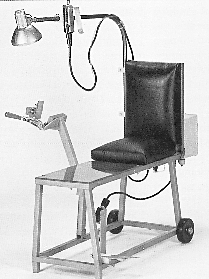
One-Man Tom Milking Bench
Patent #3,872,869
"All of these features found on our One-Man Tom Milking Bench lend themselves to the ability of one person to collect the highest quality semen, free of fecal, urates or other spermacidal material."
From equipment catalog of International A.I. Inc.
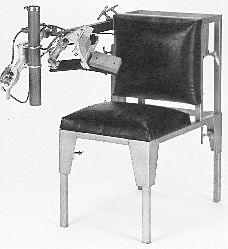
A.I. Chair & Colossus
Patent #3,880,122"With the hen immobilized by our A.I. Chair & Colossus, one person can hold, invert, and inject, obtaining higher fertility with less cost."
From equipment catalog of International A.I. Inc.
The turkey stud farm concept started in the late 1970s and early 80s. The toms are isolated from the hens, feed restricted, and sexually manipulated for their semen by "milkers." (One milker in a color slide had "love" printed on his knuckles.) Disease risk and effects are high, and "Feed restriction and semen analysis requires technically trained people [who] are often harder to find and keep."
A speaker on Beyond Freezing Semen said his topic could be retitled "The Night of the Living Dead" with music from the Twilight Zone. He discussed the creation of bird chimeras (transgenic animals with genes from other species inserted into their embryos). Regarding birds hatching with no outward (somatic) sign of desired change: "We simply throw them away." Laboratory assistants pose in a slide with smiles, each holding his or her chimera, a young chicken.
What Can I Do?
The artificial insemination of birds and other animals removes humanity farther and farther away from any possibility of establishing a civilized relationship with the rest of the living world. Tell Congress you do not want your taxes spent on the U.S. National Animal Germplasm Program, Subtitle C of the 1990 Farm Bill, "designed to maintain and enhance the collection, preservation, and dissemination of genetic material of importance to U.S. food and agriculture production [from] beef and dairy cattle, swine, poultry, sheep, goats, and aquatic forms." Tell Congress to drop this program from the 1995 Farm Bill. Contact your House Rep., U.S. House of Representatives, Wash. DC 20515; U.S. Senators, U.S. Senate, Wash. DC 2O510.