Help End the Use of Chickens in Cruel Kaporos Rituals
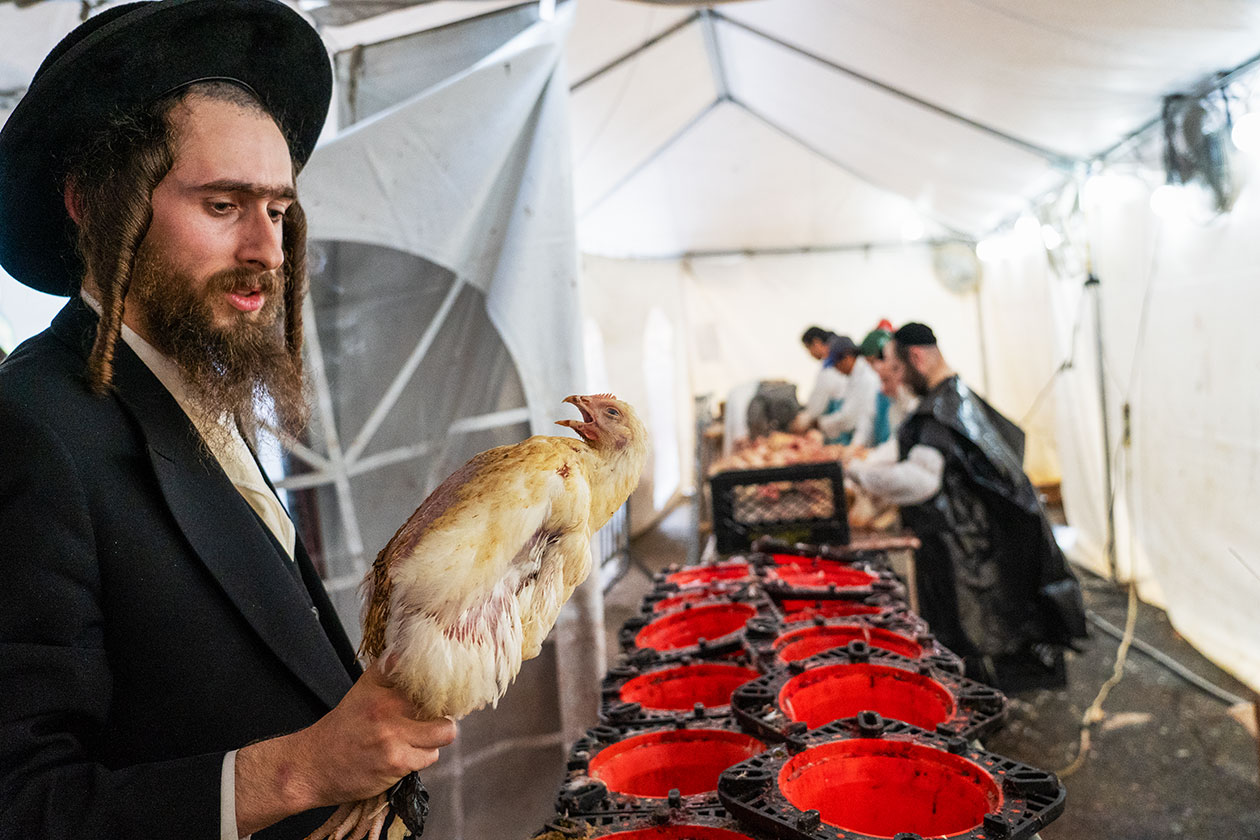
Photo by Unparalleled Suffering Photography
United Poultry Concerns has worked for decades to urge members of the Jewish community who observe the ritual of atonement known as Kaporos (also spelled Kapparot) to use money instead of chickens.
This effort is prompted by the horrific cruelty to chickens at Kaporos sites year after year in New York City, Los Angeles, New Jersey, and everywhere the ritual is conducted. Thousands of chickens are trucked onto city streets from factory farms. They are crammed in transport crates without food or water for as long as four days. They are deprived of shelter from rain, heat and cold. Often their toes and feet are ripped off during the neglectful handling of the transport crates where they sit miserably immobilized in their own feces. Many die in the crates of starvation, dehydration, heat stress, and fear. The ritual takes place the week before Yom Kippur, which falls on September 21 st this year.
What is Kaporos?
Kaporos (“atonements”) is a ritual preceding Yom Kippur - the Jewish Day of Atonement - in which chickens are “swung” and slaughtered by certain ultra-orthodox Jewish communities. Practitioners wave the chickens over their heads by the legs or by pinning the bird’s wings backward while reciting a chant about transferring their sins and punishment symbolically onto the bird. The chickens are slaughtered in the open air and claimed to be given to “the poor.”
The mistreatment of the chickens before, during and after the Kaporos ritual, when many are left alive, writhing and crying on the ground, violates the New York State animal cruelty law and desecrates the Torah mandate of Tza’ar Ba’alei Chayim, which forbids causing unnecessary pain and suffering to animals. It violates the Talmudic mandate that one must feed one’s animals before feeding oneself.
Veterinary Assessment of the Welfare of Chickens Used in Kapparot
Excerpt from the August 2026 report written by Nedim Buyukmihci, VMD, which can be read in full, including references, at www.upc-online.org/kaporos:
Chickens are so-called prey animals. They instinctively fear being handled by those who they would consider predators, including humans. With kapparot, the chickens must endure capture for transportation, the transportation itself, capture again for the kapparot, being swung around in the air and more. Being swung through the air is completely foreign to the chicken and this adds further stress.
Like all prey animals, survivability is enhanced by being able to avoid notice by predators. One of the means by which this is accomplished is by not displaying signs of disability where possible (Hansen et al. 1993), even while enduring situations known to cause substantial pain. As a result, chickens subjected to kapparot may not show outward signs of being in distress. One cannot assume, however, that this means they are not enduring pain (Gentle et al. 1987) or experiencing extreme fear as indicated by tonic immobility (Hansen et al. 1993).
Handling chickens by their legs–particularly for so-called broilers (Gentle et al. 2000; Riddell 1983)–or wings alone or by pulling back the wings to an extreme position above their backs would be painful in itself, but can also lead to injuries which exacerbate the pain. For example, pulling back the wings can lead to stretching and tearing of ligaments and other soft tissue; this is compounded when the chickens are held in this position for long periods or when they are subjected to added forces caused by being swung through the air.
Mobile Billboard Campaign Urges a Kind Kaporos: Use Money, Not Chickens
In the days before Kaporos, a mobile LED billboard truck drove through the Brooklyn neighborhoods of Williamsburg, Crown Heights, and Borough Park. For eight hours each day, September 8–10, we displayed our messages of compassion.
“What Wings Are For! Please Do a Kind Kaporos—Use Money, Not Chickens.”
and
“Kaporos: A Heartfelt Plea for Mercy—Use Money, Not Chickens.”
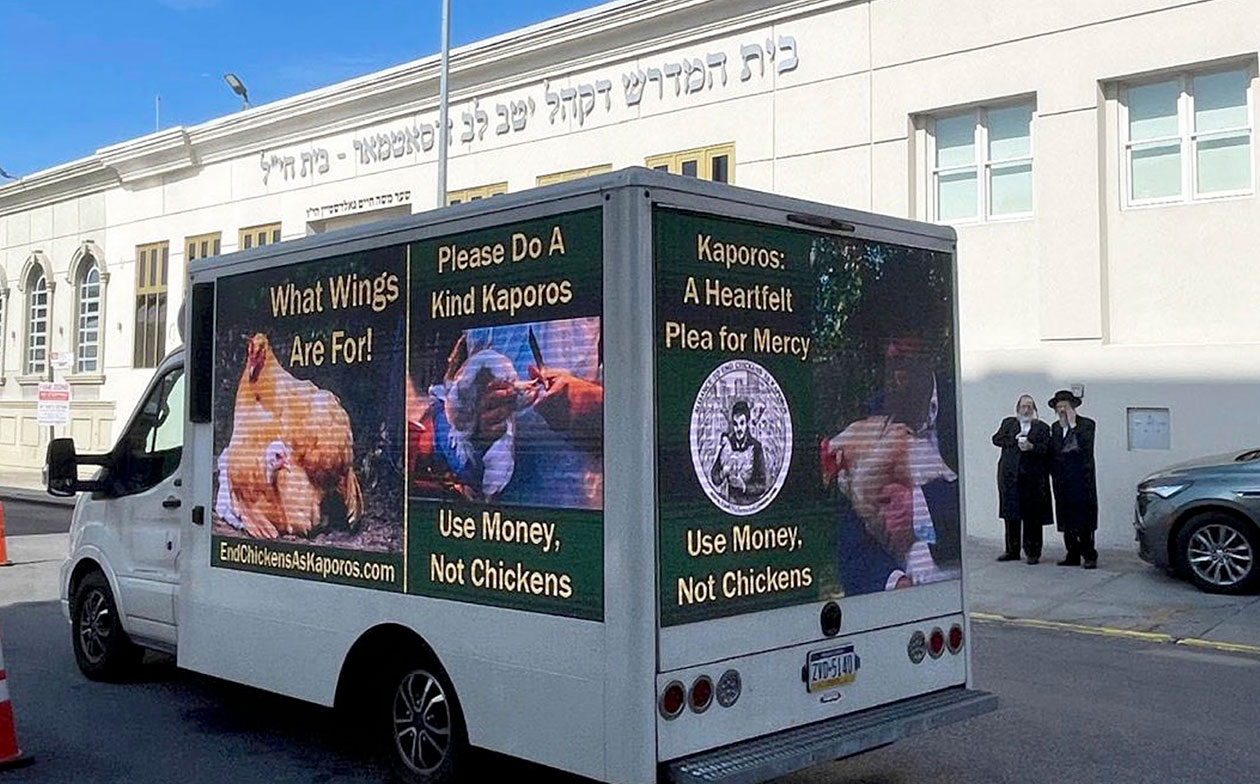
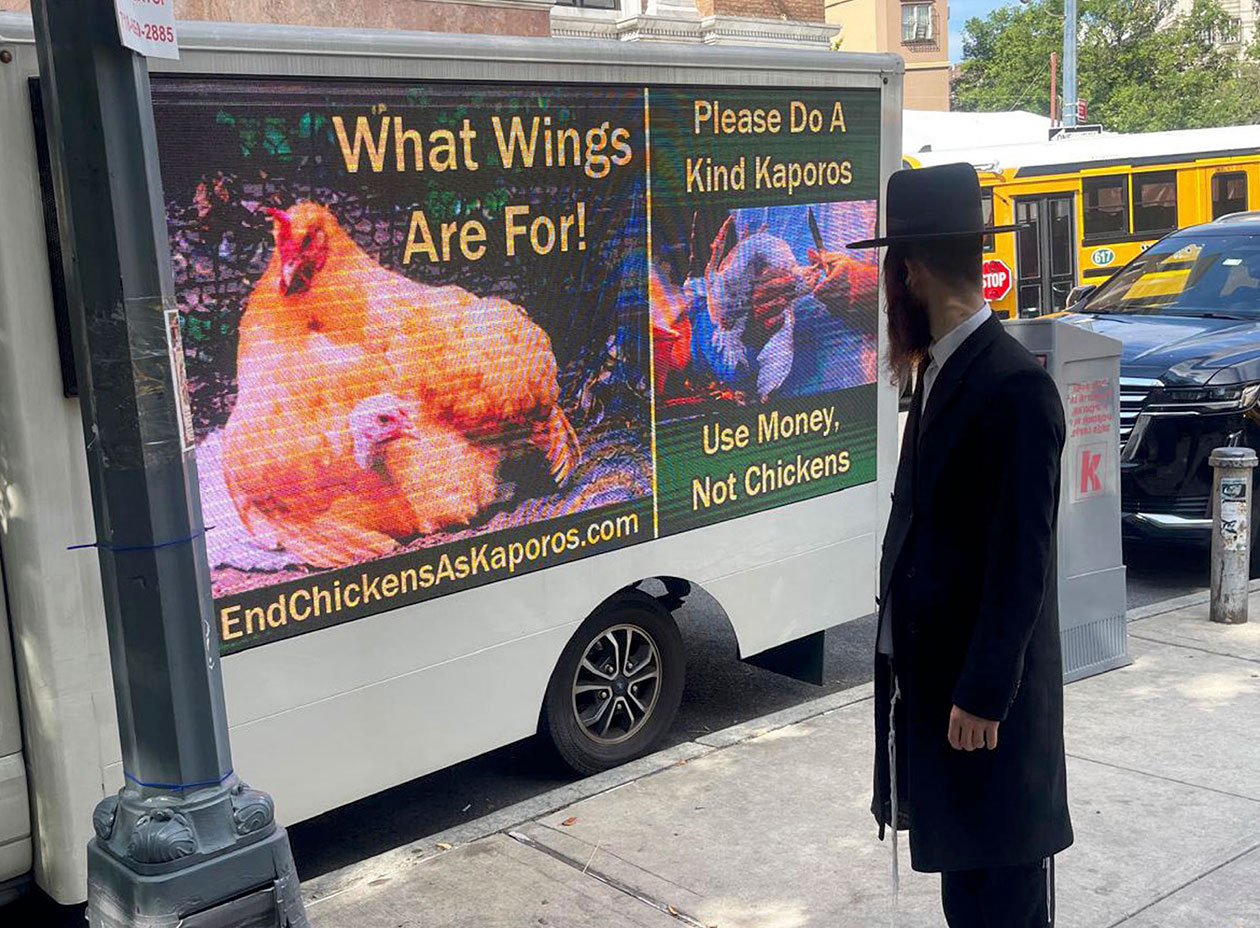
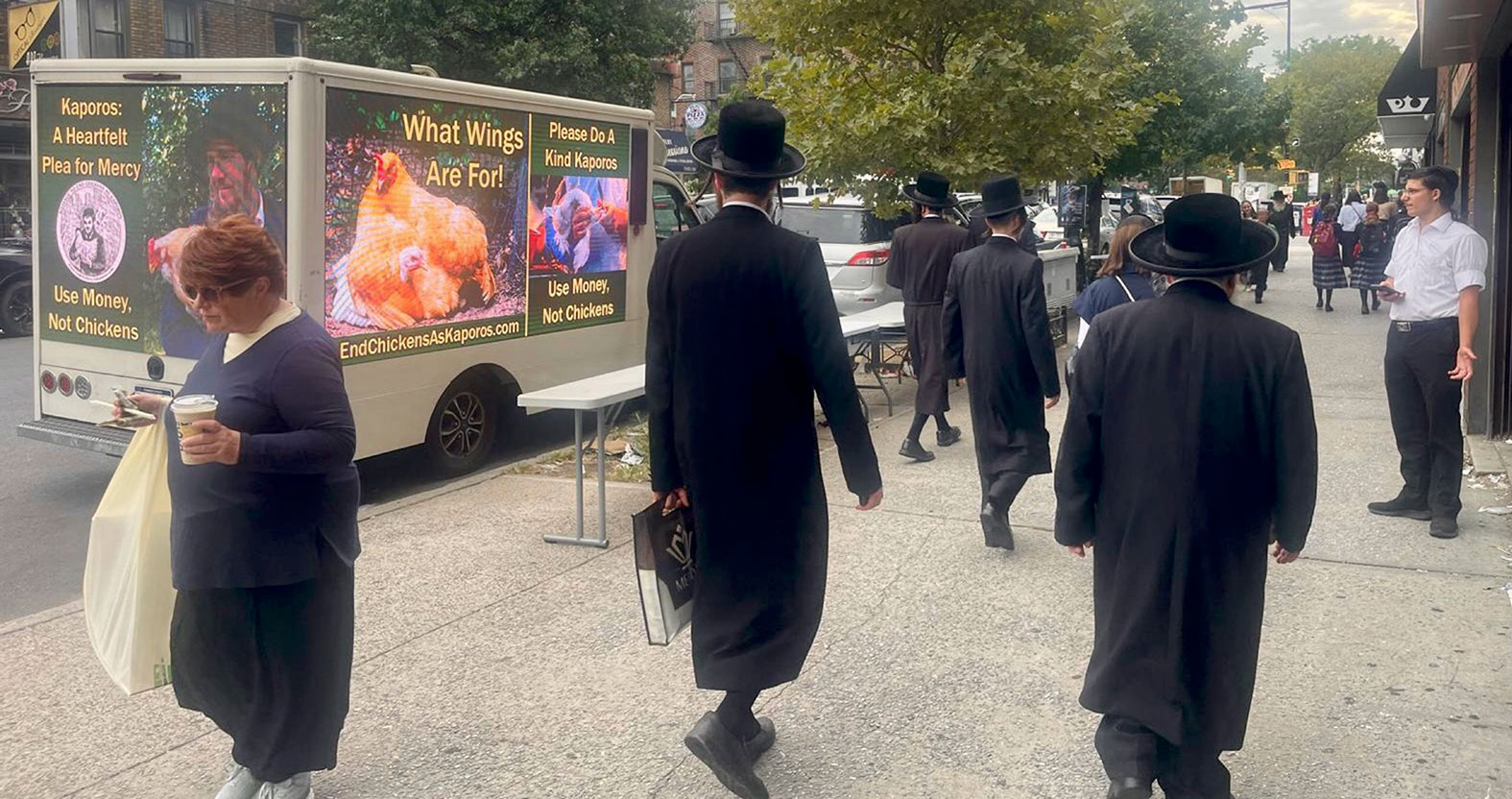

Many rabbis have come out against the use of chickens for Kaporos including some who once used chickens but now use money. This year, we have written to the Rabbinical Council of America, the Central Rabbinical Congress of the USA & Canada and 25 other Jewish organizations in New York, California, Florida, New Jersey, and Maryland, urging their leadership to promote compassion by encouraging community members to use money instead of live chickens for Kaporos.
-
Please ask the following rabbinical leaders to advocate that Kaporos be carried out with money instead of chickens.
Rabbi Etan Tokayer, President
Rabbi Menachem Penner, Executive Vice President
Rabbinical Council of America
305 Seventh Avenue, 12th Floor
New York, NY 10001
Phone: (212) 807-9000
office@rabbis.org, president@rabbis.org, mpenner@rabbis.org
Central Rabbinical Congress of the USA & Canada
85 Division Avenue
Brooklyn, NY 11249
Phone: (718) 384-6765
Email: info@crckashrus.org -
Please order our brochure, A Wing & A Prayer - The Kaporos Chicken-Swinging Ritual and distribute copies to your local news media and to anyone else who may be able to help bring an end to the use of chickens in Kaporos.
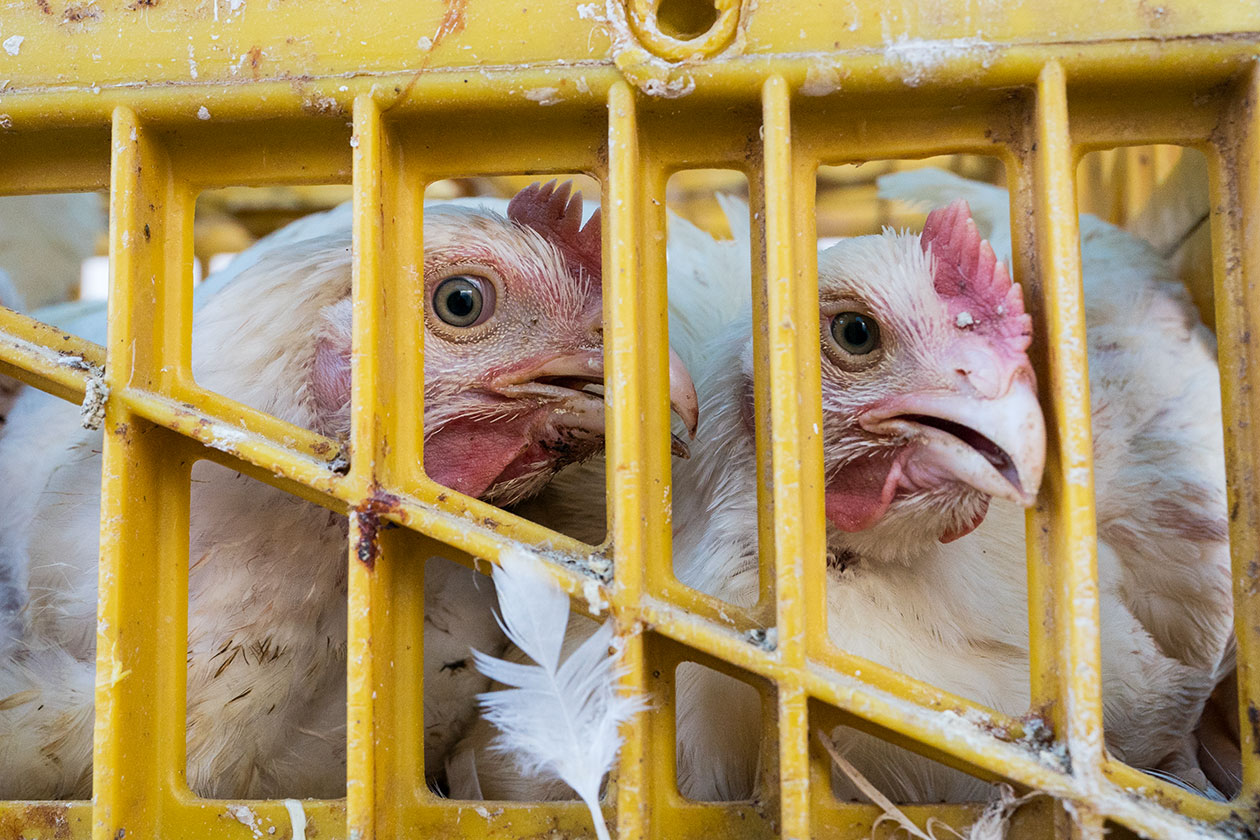
Photo by Unparalleled Suffering Photography