
Action Alert
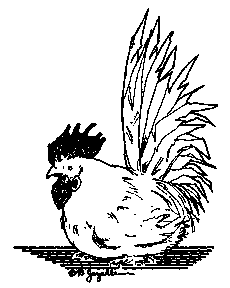
Protest Live Rooster Dismemberment Ritual
PoultryPress, Vol. 4, No.4 (Fall/Winter 1994) urged everyone to demand a stop to the satanic "rooster pull," a Spanish "tradition" carried on as a tourist attraction by certain Native American pueblos in New Mexico. At least four innocent roosters were agonizingly dismembered in June 1994 by the Acoma Pueblo and the Jemez Pueblo. UPC has written twice to The All Indian Pueblo Counsel without receiving a reply. We urge readers of On the Scene Magazine in Albuquerque to notify us immediately if a "rooster pull" is announced under "Native American Events" at any time during 1995. It's time to bury the "rooster pull" forever. Protest to: James Hena, Chairman, The All Indian Pueblo Counsel, 3939 San Pedro Drive, NE, Albuquerque, NM 87110 (505-881-1992). Protest to: Mary Tenorio, Acoma Tourist Visitor Center, P.O. Box 309, Acoma, NM 87034 (505-252-1139). Please send UPC copies of your replies.
WildBird Breaks Advertising Contract With United Poultry Concerns
After avidly pressing United Poultry Concerns to renew our advertising contract for 1995, having enjoyed our business in 1994, WildBird magazine broke the renewed contract in December 1994. The advertising director informed United Poultry Concerns that the magazine had received "four or five" complaints about our advertisement, "The Call Of The Wild Is In His Heart, Too."

WildBird faxed one protest letter to UPC on December 16, 1994, with a request that UPC respond to its charges, summarized in the letter as a "wild misrepresentation of facts." UPC president, Karen Davis, wrote an immediate, fully-documented reply substantiating every statement in the advertisement.*
Please tell WildBird how disappointed you are. You may wish to tell them that as a result of their capitulation to the poultry industry you are (whichever is appropriate) canceling your subscription; will not renew your current subscription when it expires; are not going to subscribe to WildBird as you had intended; are going to tell everyone you know how badly Wildbird behaved under pressure. Contact: Paul M. Konrad, Editor, WildBird, P.O. Box 6050, Mission Viejo, CA 92690.
* For a copy of this 11-page letter send a $5 check or money order to United Poultry Concerns, P. O. Box 59367, Potomac, MD 20859.
Coca-Cola Reconsiders Cockfighting Connection
PoultryPress Vol. 4, No. 3 (Summer/Fall 1994) reported that The Coca-Cola Company sponsored the first World Congress of Cocking in Queretaro, Mexico at Expo 1993. UPC and Friends of Animals launched a boycott/protest-letter campaign. Thanks to this effort Coca-Cola announced "a review of sponsorship policies of The Coca-Cola Company for the Latin American countries." In a letter to UPC dated November 30, 1994, Coca-Cola stated: "You will be pleased to know that our group president for Latin America has issued a policy stating that operations within Latin America should no longer sponsor or promote events, including cockfighting events, where there is a risk of physical harm to animals."
Thank Coca-Cola by contacting: Melissa Packman, Consumer Affairs Specialist, The Coca-Cola Company, P.O. Drawer 1734, Atlanta, GA 30301, 1-800-438-2653
Protest To American Airlines

Illustration by Jazelle Lieske
American Airlines sells "pâté de foie gras" in their International Duty Free catalog. Listed under "Gifts of Pleasure," foie gras is described as a "noble product" and "magic word that rings excellent and fine gastronomy perpetuated through centuries." At the same time, American Airlines writes, "We absolutely agree that the inhumane handling of any animal species is unacceptable."
Foie gras--"fat liver--epitomizes the inhumane handling of an animal species. The "noble product" is a diseased excretory organ obtained by forcing ducks and geese to consume gross quantities of fatty food by cranking a metal tube or screw down their throats and preventing them from vomiting. An eye-witness investigator in France wrote: "Before cramming, the birds were so frightened that they huddled together as far away from the farmer as they could get--pushing themselves against the bars of the cage in an attempt to escape."
Tell American Airlines to remove foie gras from their Duty
Free catalog and replace it with an elegant vegetarian pâté.
Remind them that strong business decisions, such as the banning
of smoking on commercial flights, speed public acceptance of
progressive social attitudes and customs.
Contact: Ms. M. F. White, Executive Office, American Airlines, P.O. Box 619612, MD 2400, Dallas/Fort Worth Airport, TX 75261-9612.
The goose: "a generous benefactor of mankind"
"From time immemorial the goose has been a generous benefactor of mankind, giving feathers to lie upon, quills with which to feather arrows, pens to transfer man's thoughts to paper, flesh to sustain man's body, fattened livers for the epicurean, and fat to flavor the peasant's soup and for baking purposes. . . .
"From early Roman times geese have been especially fattened to produce greatly enlarged livers. During the first part of the fattening period the feed is given in troughs, but for some days before the geese are to be killed they are forcibly fed, a funnel-like apparatus being used to force the nourishment down the birds' throats. The forced fattening of geese is depicted on mural reliefs in one of the tombs at Sakkara (Egypt).
"In France it used to be the custom to fatten geese in casks, in which holes were bored to allow the fowls to put their heads through for feeding and watering. The process used by the Poles in early times was to place each goose in an inverted earthenware pot large enough to accommodate the victim comfortably. After being fattened for even two weeks many of the geese could be removed only after the pots had been broken.
"The livers, which become enlarged to an almost incredible size, are sold separately and command a good price. In Germany, in particular, goose liver is served in a variety of ways. In Strasbourg and in other places the livers are prepared for the table in the form of pate de foie gras, a delicacy to tickle the palate of the epicurean." Morley A. Jull, "Fowls of Forest and Stream Tamed By Man," The National Geographic Magazine, Vol. LVII, No. 3, March 1930.