
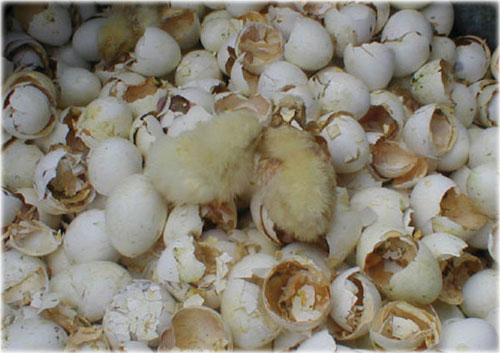
Not All They’re Cracked Up to Be
“Free-range” evokes a positive image of chickens and turkeys living outdoors with plenty of fresh air, sunshine and open space to roam in.
“Cage-free” conveys a similar impression of hens living “free” as nature intended. What are the realities behind “free-range” and “cage-free” labels?
– Joe Bob Briggs, “We Are the Weird”

After 3 days without food, birds at Polyface are stuffed into metal killing cones and brutally butchered, as in this picture of a terrified “free-range” rooster being cut to death with a knife.
Birds raised for meat may be sold as “free-range” if they have government certified access to the outdoors. The door may be open for only five minutes and the farm still qualifies as “free-range.” Apart from the “open door,” no other criteria such as environmental quality, number of birds, or space per bird, are included in the term “free-range.” A government official said: “Places I’ve visited may have just a gravel yard with no alfalfa or other vegetation.”
A visitor to Polyface Farm in Virginia wrote: “I toured Polyface on a sweltering day. Chickens were in tiny cages with tin roofs in the beating sun, panting like mad. The cages were located over manure piles the birds were supposed to eat larvae from. Rabbits were kept in factory-farm conditions in suspended, barren wire cages. There was no sign of freedom or compassion for these animals.”
Visitors to Springfield Farm in Sparks, Maryland reported: “The ‘free-range’ turkeys we saw were housed in a field in the freezing cold with no shelter except a small wooden tarp-covered structure only big enough for half of them. The others huddled together shivering in the weather. The farmer roughly grabbed the turkeys by their legs and held them upside down while they flapped their wings desperately to upright themselves. That is how he carried them.”
Photo by: East Bay Animal Advocates

“Free-range organic” young turkeys with surgically mutilated beaks at Diestel Turkey Ranch, a supplier to Whole Foods.

Severed beaks in the bottom
of a debeaking machine.
Free-range hens are typically debeaked as chicks at the hatchery the same as battery-caged hens. Debeaking is a painful facial mutilation that impairs a hen’s ability to eat normally and preen her feathers. Typically, 2,000 to 20,000 or more hens - each hen having one square foot of living space the size of a sheet of paper - are confined in a shed with little or no access to the outdoors. If the hens can go outside, the exit is often very small, allowing only the closest hens to get out. And the “range” may be nothing more than a mudyard saturated with manure.
“Pete and Gerry’s Organic Eggs” in New Hampshire exemplifies the misleading muddle of “organic,” “humane,” “free-range,” and “cage-free” advertising. Despite the “Certified Humane” logo, visitors were shocked to find 100,000 debeaked hens crowded into five 400 ft long sheds, each holding “a sea of 20,000 brown hens,” so densely crowded the floor was invisible. Though it was a mild September day in a lush green valley, the visitors said they “couldn’t see any hens enjoying the grass, just several large sheds that took up most of the farm.” The “range,” even if the hens had been outside, was just “a bare patch of dirt between the sheds.”

Chick about to be debeaked at the hatchery.

Debeaked chicks with bloody beaks.

“Cage-free” means that, while the hens are not squeezed into small wire cages, they never go outside. “Cage-free” hens are typically confined in dark, crowded buildings filled with toxic gases and disease microbes the same as their battery-caged sisters. And like their battery-caged sisters, they are painfully debeaked at the hatchery. While chickens are designed to dig in the ground for food with their beaks and claws, when deprived of outlets suited to their energies and interests, they can be driven to peck at each other, having nothing to do with their time once they’ve laid their egg for the day in a barren building. Chickens love sunlight - they sunbathe daily outdoors - but “cage-free” hens are denied even this simple pleasure.
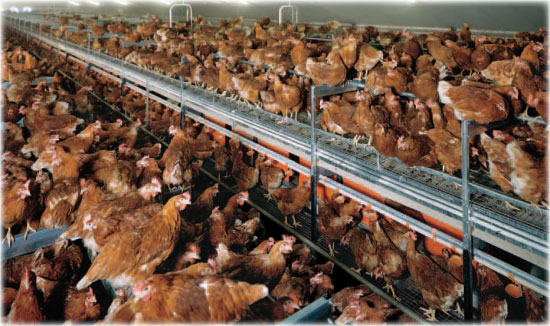
Black Eagle Farm, a “cage-free” operation in Virginia, houses 48,000 hens.
Platforms are designed to cram as many hens as possible into the building.
This is a typical large-scale commercial operation being advertised as “animal friendly.”
“Organic” Hens are Slaughtered
the Same as Birds Raised for Meat


Though chickens can live active lives for 7 to 15 years, “free-range,” “cage-free,” and “organic” hens are grabbed upside down by their legs, thrown into transport trucks like garbage, and hauled to slaughter the same as battery-caged hens at extremely young ages. Many of these gentle hens are sold to live poultry markets where they sit for days in filthy cages listening to the screams of their cagemates being butchered in the back room.
 Many hens from cage-free and battery-cage egg operations end up
in hellholes like Nick’s live poultry market in New York City.
Many hens from cage-free and battery-cage egg operations end up
in hellholes like Nick’s live poultry market in New York City.
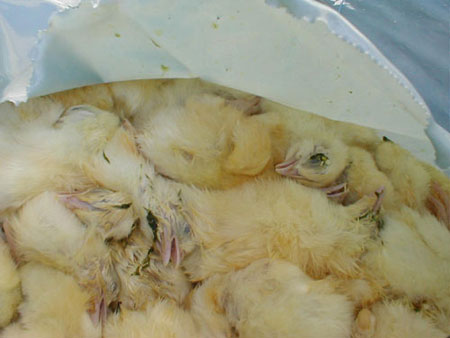
Newborn male chickens are thrown into plastic trash bags at the hatchery. This is a standard egg production farming practice throughout the world.
Egg production produces “excess” male chicks with no commercial value since male birds don’t lay eggs. Therefore, the baby brothers of all hens used for all egg production - regardless of the label - are suffocated to death in trash cans, electrocuted, gassed, or ground up alive as soon as they break out of their shells. For every “free-range,” “cage-free,” or “organic” hen, a baby rooster is born and trashed. No federal laws protect chickens from abuse under any label.

Different from Factory Farming?

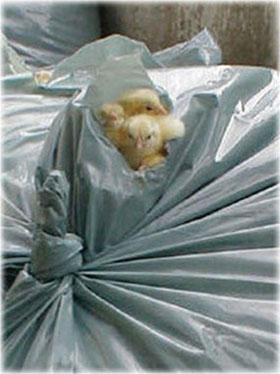
It is a myth that “free-range” poultry and egg production is separate from industrial animal production. All forms of animal production are economically related. For example, many small farms buy their birds from mega-industrial factory-farm hatcheries such as Murray McMurray in Iowa. McMurray alone ships 100,000 chicks each week to buyers. “Free-range” producers have joined together with the U.S. Postal Service, cockfighters and other vested interests to force the airlines to ship baby chicks like luggage, because it is cheapest.
Millions of chicks die enroute of starvation, dehydration and terror. Despite the factory-farm connection and total inhumaneness, Polyface owner Joel Salatin speaks for the “free-range” lobby: “We small independent producers rely on that transport. It’s our very lifeblood.” He also says: “People have a soul; animals don’t. Unlike us, animals are not created in God’s image.”
 All Hatchery Photos: Courtesy of The Animals Voice
Please show kindness and respect to birds and other animals by not eating them or their eggs or drinking their milk. Instead, discover the variety of all-vegetarian, vegan foods and cooking ideas. For recipes and cookbooks, go to www.upc-online.org/recipes/. For vegetarian and healthy food options worldwide, go to HappyCow Compassionate Eating Guide at www.HappyCow.net.
- Vinegar and Baking Soda: For a rising or lightening effect in cakes, cupcakes and breads, combine 1 teaspoon of baking soda with 1 tablespoon of vinegar.
- Ground Flaxseed: Rich in essential omega-3 fatty acids, 1 tablespoon of ground flaxseed whisked with 3 tablespoons of water in a blender or food processor will replace one egg. Flaxseed works best in nutty, grainy items like pancakes, waffles, bran muffins and oatmeal cookies.
- Bananas: For its binding abilities, half of a potassium and magnesium rich mashed or pureed banana will generally replace one or two eggs in breads, muffins, cakes and pancakes.
- Applesauce: Full of fiber and vitamin C, unsweetened applesauce offers the binding and moisture needed in baked goods. 1/4 cup equals one egg. Applesauce works best when you want the results to be moist, as in brownies.
- Silken Tofu: Rich in protein and fiber, but without the cholesterol and little, if any, saturated fat, this soy-based ingredient works best in dense, moist cakes and brownies. One egg can be replaced with 1/4 cup of tofu whipped in a blender or food processor.
- ENER-G Egg Replacer: Available in a handy box in most food stores, this nonperishable powdered product works well in baking, but is best in cookies.
United Poultry Concerns is a nonprofit organization dedicated to the compassionate and respectful treatment of chickens, turkeys, ducks and other domestic fowl. We seek to make the public aware of how these birds are treated, and to promote the benefits of a vegan diet and lifestyle. We invite you to join us and support our work. For information about all forms of poultry and egg production, see Prisoned Chickens, Poisoned Eggs: An Inside Look at the Modern Poultry Industry by Karen Davis, PhD. Order at www.upc-online.org or send $14.95 check or money order to the address below. Thank you!
PO Box 150 Machipongo, VA 23405-0150
- Joe Bob Briggs, “We Are the Weird: It’s Home, Home on the Free Range.” Telegram-Tribune (San Luis Obispo, CA), 25 March 1993, p. 24.
- Government official quoted about free range on p. 2: Dr. Hall Ricker. Interview with Karen Davis, 18 September 1992.
- Visitor to Polyface Farm in Virginia quoted on p. 2: Mary Finelli. Email to Karen Davis, 11 November 2002.
- Visitors to Springfield Farm in Sparks, Maryland quoted on p. 2: Terry Cummings, Poplar Spring Animal Sanctuary. Email to Mary Finelli, 9 December 2003.
- Diestel Turkey Ranch cited on p. 2: Christine Morrissey, East Bay Animal Advocates. “Paying the Price for ‘Pampered’ Poultry.” Satya Magazine, September 2006, pp. 38-39. www.free-range-turkey.com.
- Debeaking is painful cited on p. 3: Donald Bell and William Weaver, eds. Commercial Chicken Meat and Egg Production, 5th ed. Kluwer Academic Publishers, p. 80; Glatz, PC, ed. Beak Trimming. Nottingham University Press, 2005, p. 47.
- “Pete and Gerry’s Organic Eggs” cited on p. 3: Peter Singer and Jim Mason. The Way We Eat: Why Our Food Choices Matter. Rodale, 2006, pp. 101-107.
- Murray McMurray Hatchery cited on p. 7: Devon Spurgeon and Stephen Power. “Lawmakers Put Chicks’ Transport Up in the Air.” The Wall Street Journal, 7 November 2001.
- Polyface owner Joel Salatin quoted on airline transport of chicks on p. 7: Phil Rooney. “Farm Scene: Mail-order hatcheries may crack under new shipping restrictions.” Associated Press, 31 August 2001.
- Polyface owner Joel Salatin quoted as saying that animals don’t have souls on p. 7: Michael Pollan. “An Animal’s Place.” The New York Times, 10 November 2002.